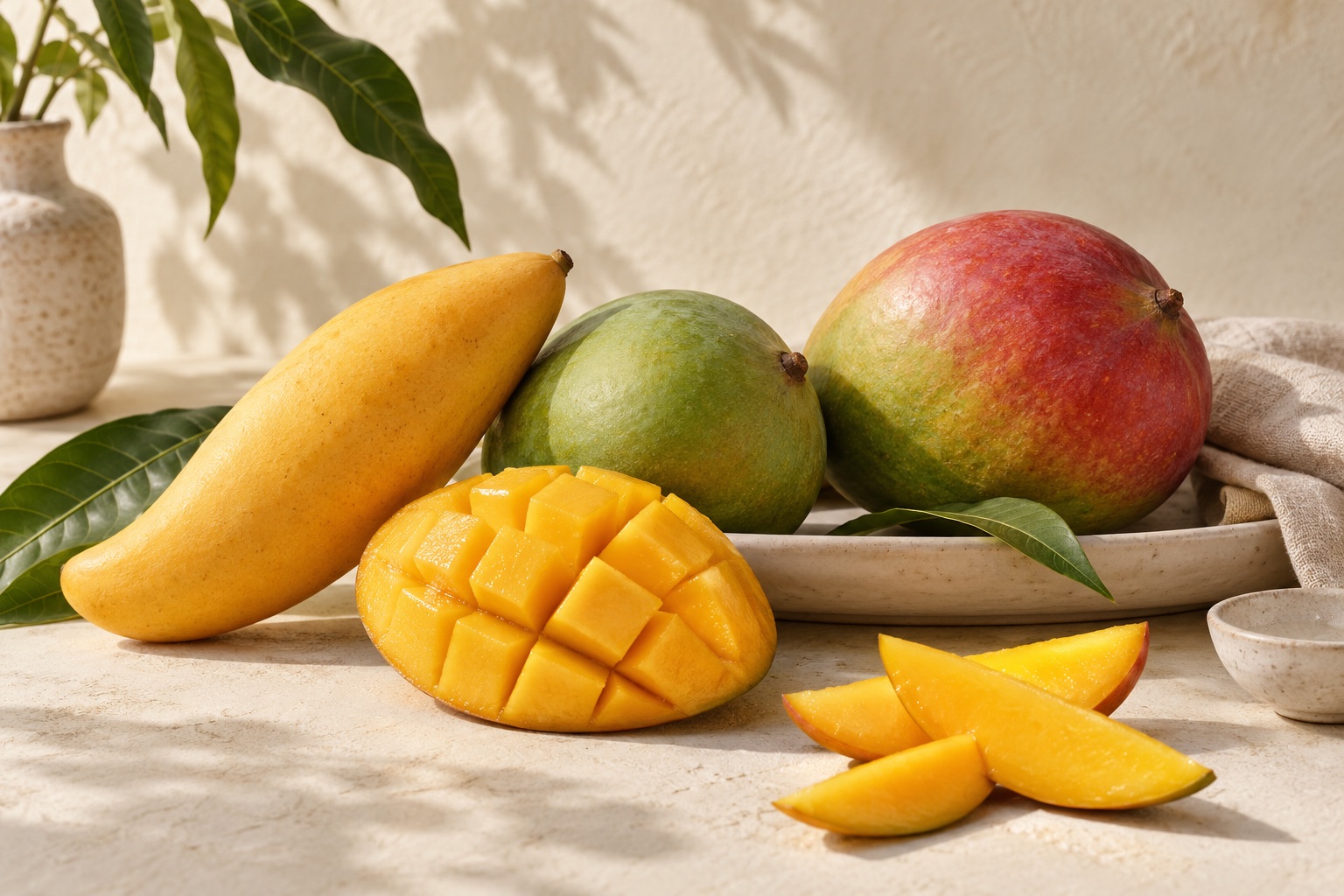
A mango is not a sweetness setting.
The name on the shelf tells you the fruit. The variety gives you a better starting point for the bite: smooth or noticeably stringy, tangy or sweet, softly yielding or more structured. But the variety name is not a promise about every individual mango.
This guide compares five varieties you may meet in U.S. produce aisles. It is a source-based shopping framework, not a taste-test ranking or a complete atlas of the world's mangoes.
Five mango varieties, side by side
The descriptions below come from the National Mango Board's cultivar guides. The final column is our suggested starting point, inferred from those descriptions—not the result of testing these varieties in recipes.
Compare at a glance · swipe the table to see all columns →
| Variety | Flavor and texture cues | A use to try |
|---|---|---|
| Honey / Ataulfo | Sweet-tart, peachy and tropical; smooth flesh without noticeable strings. | Spoonable fruit or a smooth purée. |
| Kent | Sweet with a little tartness; tender, juicy flesh with limited fibers. | Fresh slices or a blended drink. |
| Keitt | Sweet and fruity; firm, juicy flesh with limited fibers. | Cubes for a fruit plate or salsa. |
| Tommy Atkins | Subtle tropical and citrus aroma, a tart-leaning profile and noticeable fibers. | A chopped preparation when you enjoy a more textured bite. |
| Haden | Sweet-tart with peachy aroma and a possible bitter finish; fine fibers. | Fresh tasting slices to explore the flavor. |
“Fibers” here describes the strings you notice while eating. It is not a dietary-fiber measurement, and this table should not be used to rank nutrition.
A helpful first comparison is Ataulfo versus Tommy Atkins: try both when they are ready to eat, and notice mouthfeel before deciding which you prefer. Smoothness is a preference, not a quality certificate. Someone who enjoys a structured bite may make a different choice.
A red mango is not necessarily a ripe mango
The shortcut “red means ready” does not work. UC Davis identifies skin redness as an unreliable maturity indicator and notes that varieties differ in both flavor and texture. Its mango fact sheet also describes ripening-related increases in sweetness and aroma compounds, alongside declining acidity. That helps explain why the same named variety can give you different eating experiences. Source: UC Davis mango fact sheet.
Keitt is a particularly useful reminder: its skin can remain green when ripe. Honey mangoes, by contrast, can become deeper gold and develop small wrinkles. Those are variety-specific clues, not a color chart for every mango. See the Board's Keitt and Honey profiles.
For an everyday shopping decision, use three questions:
- Does it give slightly? Gently check firmness; a ripe mango yields a little, while an unripe one feels very firm.
- Is there a fruity scent near the stem? This can be an extra clue, but ripe mangoes do not always have an obvious aroma.
- When will I eat it? Decide whether you want ready-to-eat fruit or fruit to ripen at home.
These touch and aroma clues follow the National Mango Board's selection guidance. Do not squeeze hard enough to damage fruit, and do not let an attractive blush replace the firmness check.
Read the name, not just the sticker color
Look for a named variety on the shelf label or carton, or ask the produce staff. “Yellow mango” is not a cultivar name. The Board's PLU list groups multiple varieties under some color-and-size codes, so a generic produce sticker may not settle the identity. Source: mango varieties and PLU codes.
If the variety is unknown, you can still make a useful choice by checking ripeness and describing what you actually taste. Write “variety not stated” in your notes instead of guessing from the peel—or from an illustration like the cover of this article.
Let it ripen, then slow it down
Keep an unripe whole mango at room temperature. A paper bag can help it ripen faster; once it is ripe, refrigeration slows further ripening. The National Mango Board gives up to five days in the refrigerator for whole ripe mangoes. That guidance is for whole fruit, not permission to leave cut mango at room temperature. Source: ripening and storage guidance.
For shopping, think in two batches: something for today and something for later. Check the later batch as it softens rather than assuming every mango will follow the same calendar.
Once you cut it, the storage rule changes
Wash the whole mango under running water before peeling or slicing, even if you will discard the skin: cutting can carry dirt and bacteria from the surface onto the flesh. Use clean hands, a clean knife and a cutting board kept separate from raw meat. Do not use soap or detergent on the fruit. Washing reduces contamination; it does not sterilize produce. Source: FDA produce preparation guidance.
Put cut mango in a covered container and refrigerate promptly at 40°F (4°C) or below. Do not leave it out for more than two hours, or one hour when the air temperature exceeds 90°F (32°C). These limits concern food requiring refrigeration, not an intact unripe mango ripening on the counter. Sources: National Mango Board storage guidance and FDA refrigerated-food guidance.
For ready-cut mango from a shop, choose a refrigerated pack and follow its storage and use instructions. The five-day guidance above is for whole ripe mangoes; it is not a shelf-life promise for cut fruit.
What about dried mango and fruit powder?
Do not turn the fresh-fruit table into a processing league table. We have not compared these five varieties after drying or milling, and the cited cultivar descriptions do not establish one universal winner for powders, freeze-dried pieces or chewy slices.
For a processed product, ask a different set of questions: Is the cultivar stated? What process was used? What is in the ingredient list? What texture or application does the producer actually describe? Treat an unspecified cultivar as missing information, not automatically as a defect.
Start with our dried versus freeze-dried fruit guide for the process distinction, then use the Fruit Format Atlas to explore other forms. A fresh mango recommendation and a finished-ingredient recommendation answer different questions.
A small field note of your own
Next time, record four things: the stated variety, how firm it felt, the texture you noticed and what you used it for. Add a simple preference—“would buy again for slices,” for example—instead of a supposedly objective score.
That makes your next purchase more informed without pretending one mango represents an entire cultivar. The useful question is not “Which mango wins?” It is “Which mango works for this moment?”
About the sources
Cultivar and ripeness sources were checked on October 6, 2026. On October 8, we added the cut-fruit handling section, checked the linked FDA guidance and rechecked the National Mango Board storage page. The National Mango Board is an industry promotion body; its cultivar profiles are descriptive references, not independent comparative tests. UC Davis's fact sheet identifies its technical update as February 1997; checking that reference does not make it a newly published study. This article does not claim expert review, hands-on testing or universal seasonal availability.
Read our editorial approach and Oh!Crisp relationship. The illustration and AI-assisted production are disclosed separately below.