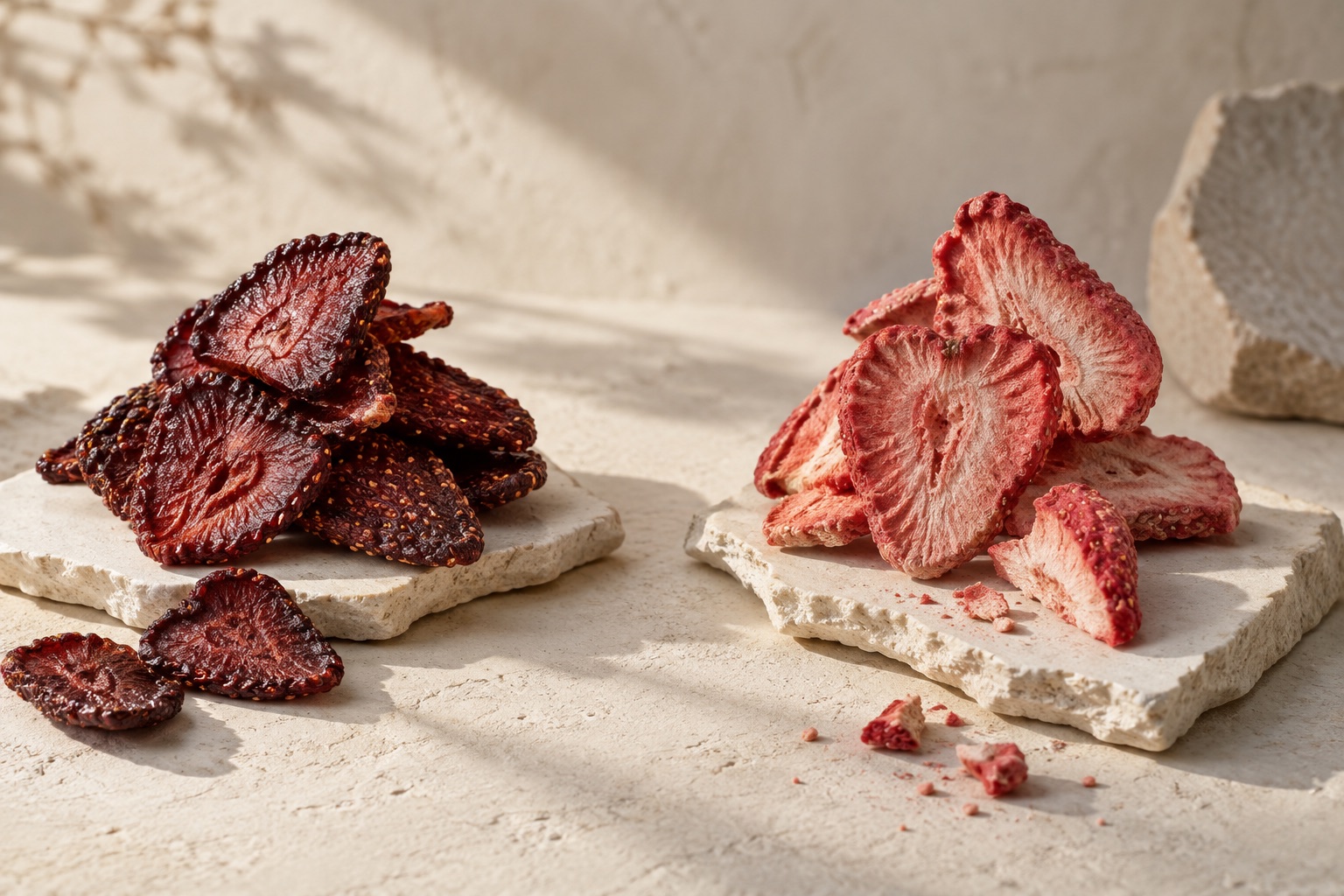
The short answer: conventional dried fruit usually offers a dense, chewy bite; freeze-dried fruit usually feels light and crisp. Both lose water, but by different routes. Neither name tells you the complete ingredient list or makes one product automatically the better choice.
Technically, freeze-dried fruit is also dried fruit. Here, “dried” means familiar evaporation-based formats such as raisins, dried apricots and chewy mango. Real products vary: a thin dehydrated apple chip can be crisp, too.
The comparison at a glance
Compare at a glance · swipe the table to see all columns →
| What changes | Conventional dried fruit | Freeze-dried fruit |
|---|---|---|
| Water removal | Mainly evaporation, often with warm air | Frozen water leaves as vapor under vacuum |
| Typical bite | Dense, chewy or leathery | Light, porous and brittle |
| Good starting use | A chewy snack or a mix that travels | A crisp topping added just before eating |
| Added sugar? | Check the label | Check the label |
| After opening | Protect from moisture and heat | Protect from moisture to preserve crunch |
This is a shopping framework, not a specification for every fruit or brand. Slice thickness, ingredients and processing conditions also shape the result.
Why the structure changes
Warm-air drying carries moisture away as it evaporates. The tissue commonly contracts as it dries. That helps explain why an apricot can become a small, concentrated piece with a very different bite. Utah State University’s drying guide describes the associated loss of size and weight.
Freeze-drying starts with frozen food. Under vacuum, ice passes directly into vapor—a process called sublimation. Removing those ice crystals can leave an open structure rather than the same degree of collapse. USU’s freeze-drying introduction explains this different physical route.
One controlled 2024 study of apricot slices found that vacuum freeze-drying produced the least shrinkage and strongest rehydration among four tested methods. It also required the longest drying time. Those are results for the study’s apricots and conditions—not promises about every retail bag.
Start with the eating moment
Our practical approach is to choose a role before choosing a process:
- For a chewy desk snack: begin with the texture you already enjoy—raisins, dried apricots or chewy mango—and compare ingredient lists.
- For a last-minute yogurt or cereal topping: try freeze-dried pieces for contrast. Add them just before eating if crunch is the point.
- For a bag that gets knocked around: consider whether broken pieces matter. A brittle snack needs gentler handling than a flexible one.
- For a recipe: use the format the recipe specifies first. Equal spoonfuls of chewy pieces and airy pieces need not contain equal weights of fruit.
These are use-case suggestions, not the results of a comparative tasting. Explore the Fruit Format Atlas for the wider family of fruit ingredients.
Working with a powder rather than pieces? Our fruit powder guide: ingredients, drying methods and uses walks through the starting material, carriers and questions to ask before choosing a powder for drinks, yogurt or baking.
Does drying mean added sugar?
No. Taking water out does not, by itself, add sugar. But a manufacturer can add sweeteners before or after processing, so check both the ingredients and the Added Sugars line instead of relying on the front-of-pack format name.
For U.S. labels, the FDA distinguishes naturally occurring sugars from added sugars. Whole fruit’s naturally occurring sugar and sugar added during manufacture are not the same labeling category. “Freeze-dried” alone is not a no-added-sugar claim.
Compare the serving weight alongside the numbers. A larger-looking pile of airy pieces is not necessarily a larger serving by weight.
Compare two bags on the same basis
Start with the grams next to the serving size, not the apparent size of a handful. The FDA's serving-size guide explains that Nutrition Facts usually describe one serving, while some labels also show a whole-package column. A labeled serving reflects customary consumption; it is not a recommended amount to eat.
- Check the column. Are you reading values per serving or per package? Check how many servings the bag contains before treating it as one portion.
- Use an equal weight for comparison. If one label gives values per 20 g and another per 30 g, multiply the first label's calorie and nutrient amounts by 1.5 to estimate values per 30 g. This is an illustrative calculation, not a tested product comparison or a suggested portion. Label rounding limits its precision.
- Return to what you will actually eat. Equal-weight figures help compare the two products, but your portion determines the amount you consume. Keep Total Sugars and Added Sugars separate, and read each ingredient list alongside the numbers.
This compares finished products by weight; it does not show which process retained more nutrients from an equal starting amount of fresh fruit. Use the natural fruit flavor guide if flavor declarations make the ingredient lists harder to compare.
Is one more nutritious?
The process name alone cannot settle that question. The apricot study above reported better retention of several measured nutrients with vacuum freeze-drying than with the other tested methods. That supports a specific processing comparison, not a universal health ranking.
USU notes that vitamin C losses during drying vary with treatment. Fruit variety, the process and what happens afterward all deserve attention; avoid treating “preserves everything” as a reliable description. For an actual purchase, use the product’s nutrition information and your intended serving, rather than transferring research values to an untested brand.
Keep the texture you paid for
Moisture content and water activity are different. Water activity describes water availability, not simply how much water a food contains. The FDA’s technical explanation makes that distinction. You cannot infer a product’s shelf life from its crispness.
Drying limits microbial growth; it does not make food sterile. USU’s drying guidance recommends protection from moisture, heat and light. Reseal promptly, use dry utensils, and follow the package’s storage and after-opening instructions. Do not apply a generic internet shelf-life number to every bag.
The takeaway
Choose for the bite and the application, then read the label. Chew and crunch are different experiences—not a hierarchy of authenticity or health.
Before comparing processes, get to know the fruit: our mango varieties guide separates cultivar characteristics from ripeness and suggested uses.
If the ingredient list includes added flavor, our natural fruit flavor label guide explains how to read that declaration alongside the fruit ingredients.
Want to know who is behind the guide? Read our editorial approach and Oh!Crisp relationship.
Review note — October 15, 2026: added the serving-weight comparison method and checked FDA serving-size, added-sugar and water-activity guidance plus USU drying guidance. The existing 2024 apricot findings were cross-checked against the publisher-supplied abstract in FAO AGRIS. This is a source-check date, not a new publication date or a hands-on test.