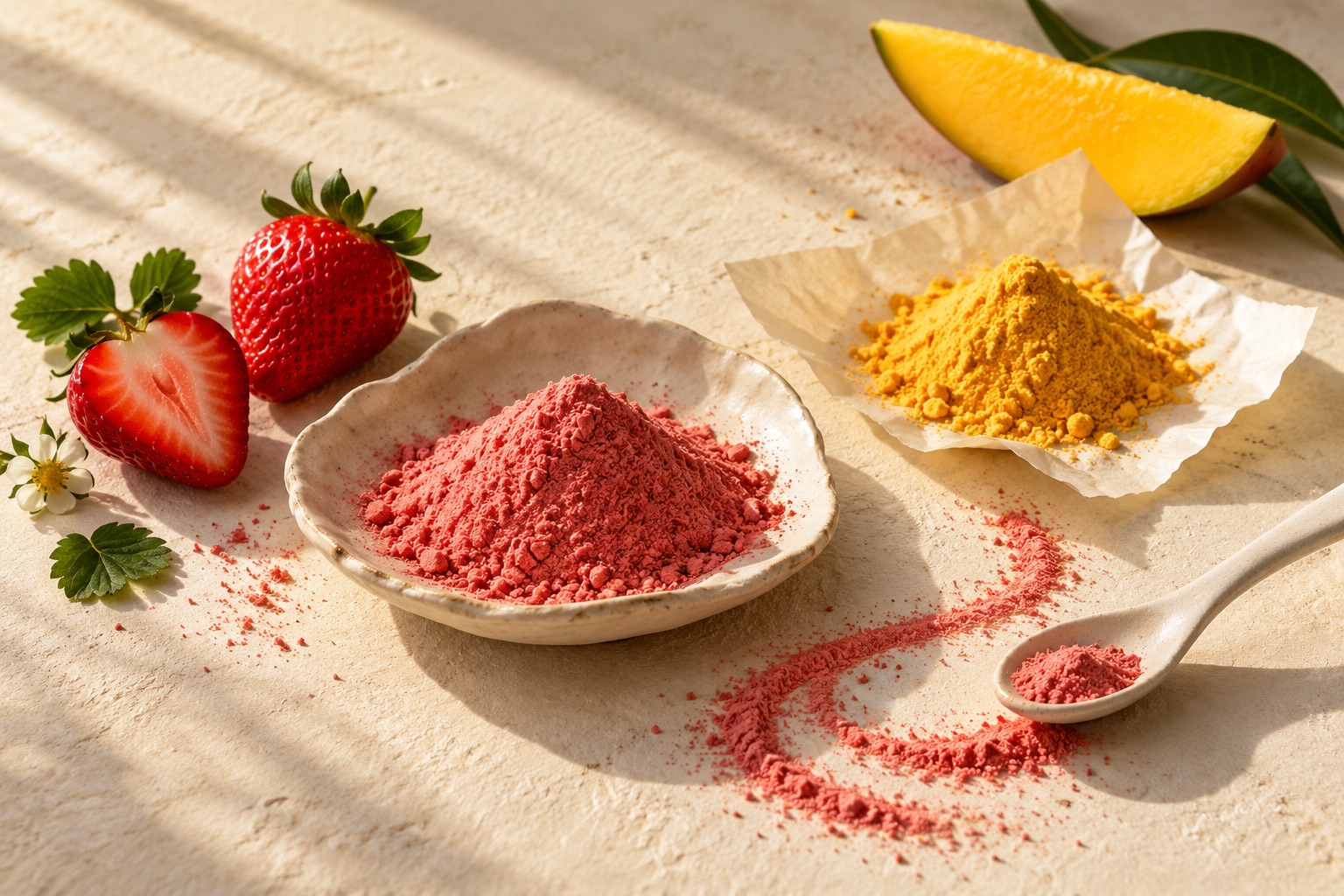
The short answer: Fruit powder is a format, not a complete ingredient description. Ask what went into it, how it was dried, and whether it suits your intended use. This guide covers food ingredients, not supplements or medical nutrition.
Two jars can both say “strawberry powder” while leaving you with different shopping questions. Is the starting material fruit flesh or juice? Is anything added? Does the manufacturer intend it for a smoothie, a drink mix or a dry topping?
Our first rule is to separate composition from process. “Freeze-dried” answers a processing question. It does not, by itself, answer every question about the recipe.
Start with the material, not the front-of-pack color
Think of the following as questions to investigate, not legally standardized categories or a ranking of better and worse products.
Compare at a glance · swipe the table to see all columns →
| Description you encounter | What to establish | Useful next question |
|---|---|---|
| Fruit or pulp powder | Which parts of the fruit were used, and whether anything was removed or added | Does the maker specify peel, seeds, pulp or a purée? |
| Juice powder | What juice went into the powder, and its other ingredients | Was it clarified, and are carriers included? |
| Freeze-dried fruit powder | Both the starting material and the full formula | Is it fruit alone, or a blend dried by that method? |
| Fruit-flavored powder or drink mix | The complete mixture rather than the pictured fruit | What supplies the fruit ingredient, sweetness and flavor? |
These distinctions are not theoretical. In one published experiment, researchers prepared apple pulp, blended it with selected wheat proteins, freeze-dried it and then milled and sieved the material. In another, researchers clarified pomegranate juice and spray-dried formulations with different carriers. Those are different recipes as well as different processes. Apple-powder methods, Yang and colleagues, 2022; pomegranate-juice methods, Yousefi and colleagues, online 2010, journal issue 2011.
The practical inference: do not assume every freeze-dried powder is single-ingredient, or that every juice powder contains the same carrier.
Freeze-drying and spray-drying answer different process questions
Freeze-drying removes ice from frozen food as vapor through sublimation. That is the core distinction explained by Utah State University Extension. A powder-making workflow can also include milling after drying, as the apple experiment above demonstrates.
Spray-drying starts with a liquid feed dispersed into a drying chamber. The pomegranate experiment used a nozzle and heated air to produce powder; the researchers varied the carrier formulation and measured the resulting properties. It is evidence about that system, not a universal verdict on every fruit powder.
Neither method name alone gives you a finished product's flavor intensity, fiber content, mixing performance or shelf life. For a broader explanation of fruit formats before they become powders, see dried versus freeze-dried fruit.
Why is maltodextrin in a fruit powder?
A carrier is an added material used as part of making the powder. It can have a technological job rather than merely making the ingredient list longer.
In the pomegranate spray-drying study, tested carriers included maltodextrin, gum arabic and waxy starch. Carrier choice affected powder recovery and solubility; the researchers also reported less material deposited on dryer walls when carriers were used. Read the original carrier experiment.
Our buying takeaway is not “avoid all carriers” or “carriers are always necessary.” Ask what a particular formulation is designed to achieve. If you want fruit alone, look for a clear single-ingredient declaration. If you need a drink ingredient, ask for mixing instructions and evidence of performance in that application. Do not assume a short ingredient list guarantees the result you want.
Carriers and anti-caking agents are not interchangeable descriptions. FDA lists anti-caking agents as ingredients used to keep powders flowing and limit moisture absorption, with silicon dioxide among its examples. A listed additive may have more than one function. FDA's ingredient-function guide.
Read the label in two passes
First, identify the ingredients. For conventional U.S. packaged foods, declared ingredients generally run from greatest to least weight. Exceptions include properly identified groups present at 2% or less, and there are rules for components of compound ingredients. Ingredient order is useful, but it does not reveal an exact fruit percentage by itself. 21 CFR 101.4.
Then, read Nutrition Facts. Check the serving weight and the amounts of dietary fiber, total sugars and added sugars actually declared. FDA explains that the panel generally describes one serving, unless another basis is indicated. Compare equivalent weights if you want a like-for-like label comparison, then consider the amount you will actually use. FDA's label-reading guide.
Do not infer “sugar-free” from “no added sugar”: total sugars include naturally occurring sugars as well as added ones. FDA's explanation of total and added sugars.
A fruit powder also should not be treated as nutritionally interchangeable with a flavor ingredient just because both create a fruity impression. Our natural fruit flavor guide explains why flavor terminology and nutritional information answer different questions.
For a step-by-step shopping routine and an annotated fictional example, see how to read a fruit snack label.
Choose for the application, not a universal winner
The following are our editorial evaluation prompts, not recipes we have tested or guaranteed substitution ratios.
- For yogurt or a smoothie: ask whether the powder is intended for that base. In a small trial, note taste, visible particles and the texture after mixing—not just its color in the jar.
- For a drink: ask about recommended liquid temperature, mixing method and sediment. A powder dispersing through liquid is not necessarily the same thing as all of it dissolving.
- For baking: look for a recipe developed for the specific powder. Do not assume that replacing fresh fruit, juice or flour spoon-for-spoon will preserve the recipe's balance.
- For a dry topping: consider the desired fineness and the manufacturer's handling instructions. Buy a quantity you can realistically use under the stated storage conditions.
If a seller cannot explain the starting material or intended use, that is a reason to ask more questions—not proof that the product is unsafe or poor quality.
What clumping can—and cannot—tell you
In the apple-powder experiment, humidity and the added protein formulation affected moisture uptake and caking. That supports a limited point: composition and storage conditions matter together. It does not establish a universal humidity limit or shelf life for powders in your kitchen. Original apple-powder study.
Our practical recommendation is to follow the package's storage and after-opening instructions, keep the closure secure and use a clean, dry utensil. Do not use a powder's free-flowing appearance—or its clumps—as your only safety assessment. If moisture has entered the package or its condition is uncertain, ask the manufacturer rather than assuming a label date still settles the question.
Five questions worth asking before buying
- What fruit material is used: flesh, pulp, purée, juice or another preparation?
- What is the complete ingredient list, including any carrier?
- Which drying method is used, and is that stated by the manufacturer?
- What use and mixing method does the maker recommend?
- What are the serving weight, nutrition information and after-opening instructions?
The best choice is the powder whose identity and intended job you can explain. “Fruit,” “freeze-dried” and an appealing color are starting points—not substitutes for that explanation.
Sources and scope
Sources were checked on October 20, 2026. This is the checking date, not a claim that older studies are new. The pomegranate paper appeared online December 25, 2010 and in the December 2011 issue; the apple paper was published September 28, 2022. Both report particular experimental formulations, not a survey or ranking of retail products.
The eCFR page displayed Title 21 current through October 16, 2026 when checked. Label discussion is limited to a general U.S. conventional-food reading framework, not legal compliance advice. No product was purchased, sampled or laboratory-tested for this article.