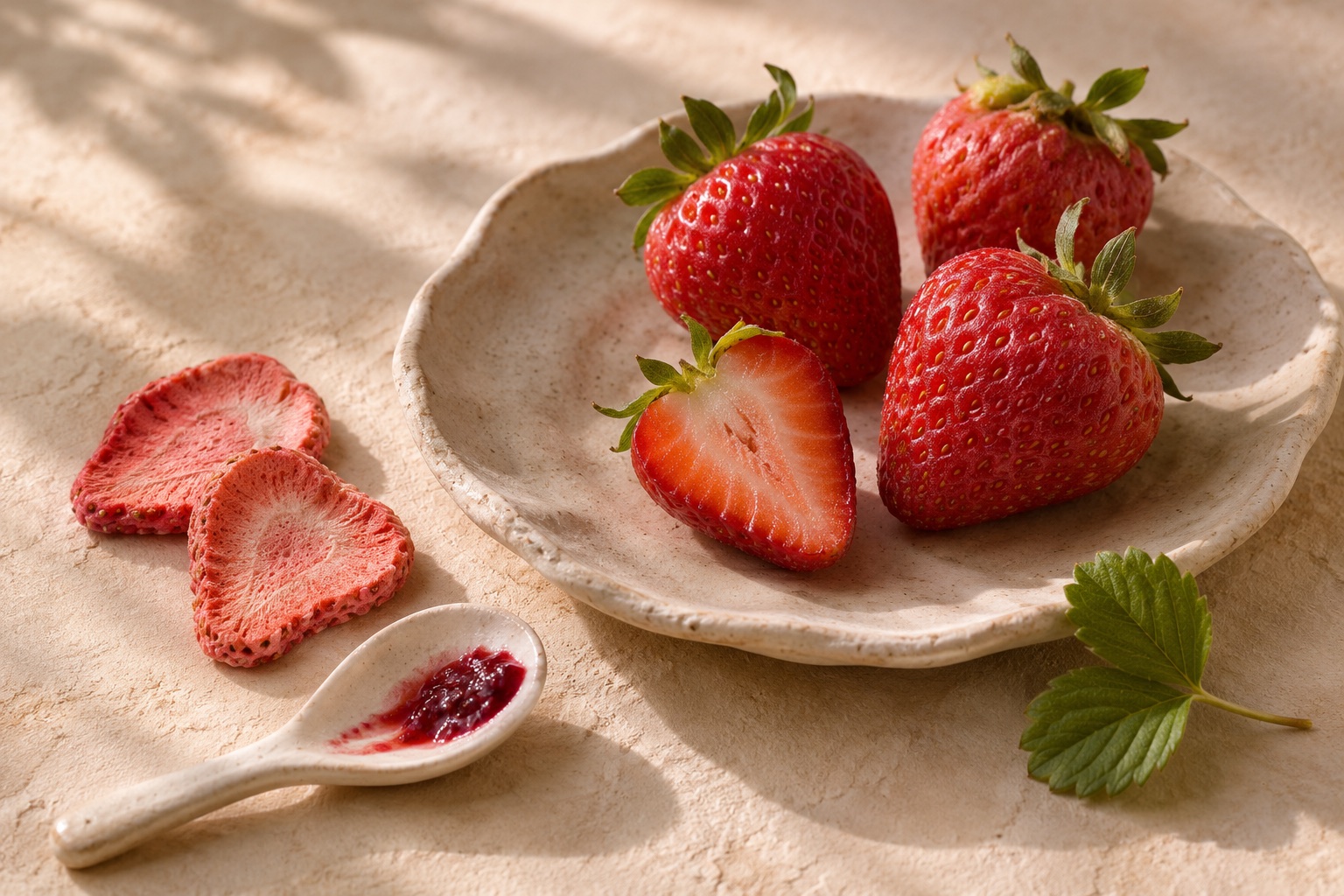
The short answer: Strawberry flavor is a combination of taste, aroma and texture. Variety, growing conditions, harvest ripeness and processing can all matter. A stronger strawberry smell does not, by itself, tell you how much sugar is present.
You buy a carton of strawberries, enjoy it, then buy another that looks much the same. The second feels sharper, quieter or simply less interesting. “Not sweet enough” is an easy verdict—but is sweetness really the missing part?
This guide offers a more useful way to describe the difference. It draws on published research and university guidance, not a tasting conducted by Best Fruit Snacks. Our observation framework is a starting point for your own notes, not a product ranking.
Sweetness is not the whole flavor
Sweet and sour are taste qualities. Aroma adds another layer, including odors reaching the nose from the mouth during chewing. Temperature and texture also contribute to the overall experience. NIH's NIDCD explains how these sensations combine into flavor.
For a strawberry, it is therefore useful to ask two questions separately: “How sweet does this taste?” and “How much strawberry aroma do I notice?” A berry can disappoint on the second question even when the first seems acceptable.
In a seven-year study of 148 strawberry samples, Fan and colleagues combined consumer ratings with chemical measurements. Models incorporating aroma compounds predicted sweetness and liking better than models relying on sugars and acids alone; some volatile compounds were associated with perceived sweetness independently of sugar content. These are research relationships, not a way to measure the sugar in your snack by smelling it. Fan et al., 2021.
For shopping: keep your flavor preference separate from a nutrition comparison. “Tastes sweeter” is a sensory judgment, not a grams-of-sugar result.
Variety and harvest conditions both matter
There is no single aromatic template shared by every strawberry.
Schwieterman and colleagues studied strawberry chemistry alongside consumer responses and found distinct volatile profiles among cultivars, as well as variation across harvest conditions. Sweetness, flavor intensity and texture liking were important to overall liking in their study. The results support looking beyond one trait, rather than declaring one universally best berry. Schwieterman et al., 2014.
The practical implication is modest: a cultivar name can be useful context, but it is not a flavor guarantee for every carton. If you find a berry you particularly enjoy, record the variety when given, origin, seller and purchase date. Those notes can help you ask a better question next time; they cannot isolate the cause of a difference.
For instance, “I liked this batch's aroma and softer texture” is more informative than “all berries from this country are sweeter.” One purchase does not establish a rule about an origin or a season.
Ripeness needs to happen before the shopping basket
Strawberries should not be bought with the expectation that time on the counter will complete their flavor development. UC Davis advises harvesting them nearly fully ripe. Rutgers adds an important distinction: berries can develop a little more color after harvest without an improvement in flavor. UC Davis strawberry guidance; Rutgers postharvest fact sheet.
Our buying takeaway is to choose for the eating experience you want now, not for a promised transformation after purchase. Appearance is one clue, not a complete flavor assessment. Nor does a dark red color tell you a berry's sugar concentration or identify its cultivar.
These are longstanding postharvest references, not new findings from 2026. Their dates and the research dates below are kept separate from this article's review date.
Processing creates another comparison—not a shortcut to “best”
What happens when the berry becomes a frozen ingredient, a dried piece or a preserve?
Abouelenein and colleagues compared measured volatile profiles in fresh, frozen and differently dried strawberries, with commercial jams also examined. The profiles differed across treatments. But this was chemical analysis under specified processing conditions, not a consumer preference test of every strawberry product. The commercial jams also differed in formulation, so they are not a same-recipe experiment. Abouelenein et al., 2021.
That distinction matters when reading a claim such as “preserves the most flavor.” Which compounds were measured? Under what conditions? Did anyone assess liking? A chemical profile and an enjoyable eating experience answer related, but different, questions.
For a practical format comparison, see dried versus freeze-dried fruit. If you are choosing a powdered ingredient, our fruit powder guide helps separate starting material, drying method and formulation. Neither a process name nor a fruit picture describes the complete finished food.
A small vocabulary for a more useful tasting note
You do not need to name aroma molecules. Start with ordinary words and explain what you mean by them.
Compare at a glance · swipe the table to see all columns →
| What to notice | Words you might try | A useful question |
|---|---|---|
| Sweet–tart balance | Mild, sweet-led, tart-led, balanced | Which impression arrives first? |
| Fresh or green impression | Leafy, freshly cut, barely noticeable | Do I notice this before tasting, while chewing, or neither? |
| Fruity or floral impression | Berry-like, perfumed, rounded, faint | Is the aroma distinct even when sweetness seems mild? |
| Preserve-like impression | Jammy, cooked-fruit, confection-like | What familiar food does this remind me of? |
| Texture and finish | Juicy, crisp, chewy, brief, lingering | What changes as I chew, and what remains afterward? |
This is our editorial vocabulary panel, not a standardized sensory lexicon or a report of tested samples. Descriptors are prompts, not diagnoses: writing “jammy” does not prove heating, and writing “green” does not establish harvest ripeness. Different people may choose different words for the same food.
Compare two foods without overclaiming the result
Choose two strawberry foods you already eat and follow their preparation and storage instructions. This is a preference exercise, not a safety test; do not taste questionable food to assess it.
- Write down the context. Note the date, food format, label ingredients and whether each sample is chilled or at room temperature. Photograph the package if you want to remember the exact product.
- Separate the observations. Describe the aroma before tasting, the sweet–tart balance, then texture and the finish. Leave a blank if a descriptor does not fit.
- State a preference for a purpose. “I prefer this texture for snacking” is a useful conclusion. “This process is always superior” is not supported by comparing two different products.
Different brands may use different fruit, recipes and handling conditions. Your notes can identify what you enjoy without determining which of those factors caused it. Repeating the comparison later may reveal a new preference—or simply another batch.
For products with added flavor, pair that sensory note with our natural fruit flavor label guide. Enjoyment and ingredient identity deserve separate questions.
The takeaway
Instead of asking whether a strawberry is “good” in the abstract, ask what you want from it: sweetness, a clear berry aroma, tartness, juiciness or crunch. Then describe what is actually there. That is a more useful starting point for choosing fruit than expecting every strawberry, in every form, to taste the same.
Sources and editorial transparency
Sources checked November 3, 2026. The linked primary studies were published in 2014 and 2021; they are not presented as current-week discoveries. The October 2021 correction to Fan et al. adds a contributing author. UC Davis dates its fact sheet to August 1996; Rutgers dates its guidance to September 2016.
This is a researched explanation, not a hands-on product test, a nutrition analysis or expert sensory certification. AI assistance supported drafting and source synthesis; the cover is an AI-generated illustration, not evidence of testing. Best Fruit Snacks' founder is also behind Oh!Crisp. That affiliation does not establish a preference result for any brand. See our editorial approach and affiliation disclosure.